




Problem Statement:
In this problem, we will be given a binary search tree and we have to convert the Binary search tree into a min-heap. This condition is applied to all the nodes in the converted Min Heap.
What is Min-Heap?
Min – Heap follows the property of a complete binary tree in which the value of the internal node is smaller than or equal to the value of the children of that node.
In 0 – based indexing, the node stored at k index in the array will have its left child held at index 2k + 1 and its right child at index 2k + 2.

What is BST?
Binary Search Tree is a type of binary tree which satisfies the following properties:
- The left subtree of any node contains only nodes with value smaller than the parent’s node value.
- The right subtree of any node contains only nodes with values bigger than the parent’s node value.
- The left and right subtree each must be a BST.

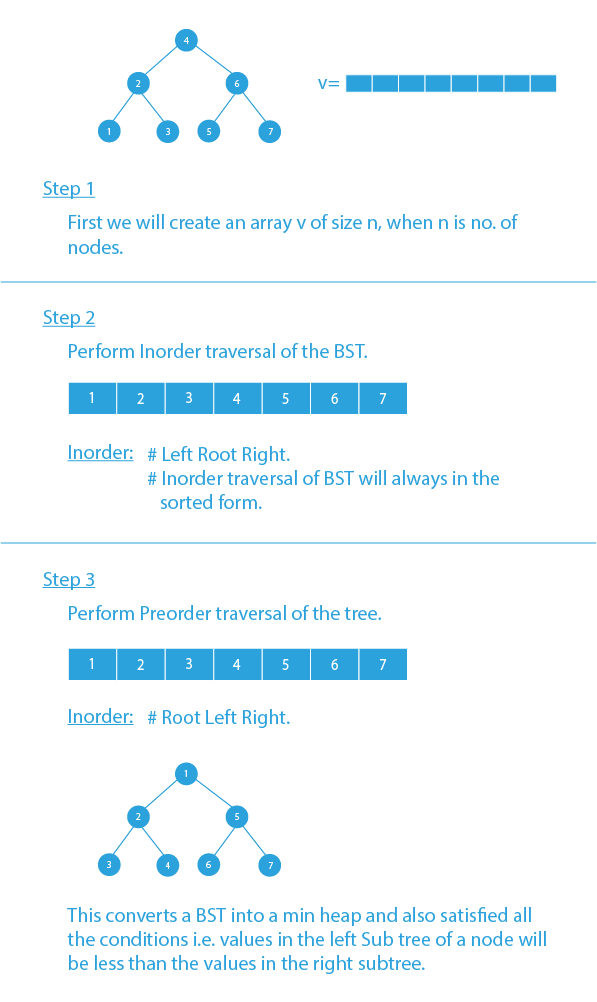
Let’s take an examplefor understanding the problem statement:

In this example, all the given conditions are satisfied i.e. the value in the left subtree of a root node should be less than the values of the right subtree of the root node.
Algorithm:
- Create an array of size n, where n is the number of nodes in the given BST.
- Perform the inorder traversal of the BST and copy the values of the nodes in the array.
- Now Perform the preorder traversal of the BST.
- While traversing the BST in a preorder manner, copy the values one by one from the array to the nodes.
Dry Run:
Code Implementation
#include <bits/stdc++.h>
using namespace std;

struct Node {
    int data;
    Node *left, *right;
};

struct Node* getNode(int data)
{
    struct Node* newNode = new Node;
    newNode->data = data;
    newNode->left = newNode->right = NULL;
    return newNode;
}

void preorderTraversal(Node*);

void inorderTraversal(Node* root, vector<int>& arr)
{
    if (root == NULL)
        return;

    inorderTraversal(root->left, arr);

    arr.push_back(root->data);

    inorderTraversal(root->right, arr);
}

void BSTToMinHeap(Node* root, vector<int> arr, int* i)
{
    if (root == NULL)
        return;

    root->data = arr[++*i];

    BSTToMinHeap(root->left, arr, i);

    BSTToMinHeap(root->right, arr, i);
}

void convertToMinHeapUtil(Node* root)
{
    vector<int> arr;
    int i = -1;

    inorderTraversal(root, arr);

    BSTToMinHeap(root, arr, &i);
}

void preorderTraversal(Node* root)
{
    if (!root)
        return;
    cout << root->data << " ";

    preorderTraversal(root->left);

    preorderTraversal(root->right);
}

int main()
{
    // BST formation
    struct Node* root = getNode(4);
    root->left = getNode(2);
    root->right = getNode(6);
    root->left->left = getNode(1);
    root->left->right = getNode(3);
    root->right->left = getNode(5);
    root->right->right = getNode(7);

    convertToMinHeapUtil(root);
    cout << "Preorder Traversal:" << endl;
    preorderTraversal(root);

    return 0;
}
import java.util.ArrayList;

class PrepBytes {

    static class Node {

        int data;
        Node left, right;

        Node()
        {
            this.data = 0;
            this.left = this.right = null;
        }

        Node(int data)
        {
            this.data = data;
            this.left = this.right = null;
        }
    }

    private static void preOrder(Node root)
    {
        if (root == null)
            return;
        System.out.print(root.data + " ");
        preOrder(root.left);
        preOrder(root.right);
    }

    private static void bstToArray(Node root,
                                   ArrayList<Integer> arr)
    {
        if (root == null)
            return;

        bstToArray(root.left, arr);

        arr.add(root.data);

        bstToArray(root.right, arr);
    }

    static int index;
    private static void arrToMinHeap(Node root,
                                     ArrayList<Integer> arr)
    {
        if (root == null)
            return;
        root.data = arr.get(index++);

        arrToMinHeap(root.left, arr);
        arrToMinHeap(root.right, arr);
    }
    static void convertToMinHeap(Node root)
    {
          index = 0;
        ArrayList<Integer> arr = new ArrayList<Integer>();
        bstToArray(root, arr);

        arrToMinHeap(root, arr);
    }

    public static void main(String[] args)
    {

        Node root = new Node(4);
        root.left = new Node(2);
        root.right = new Node(6);
        root.left.left = new Node(1);
        root.left.right = new Node(3);
        root.right.left = new Node(5);
        root.right.right = new Node(7);

        System.out.print(
            "Preorder Traversal Before Conversion :"
            + "\n");
        preOrder(root);
        convertToMinHeap(root);

        System.out.print(
            "\nPreorder Traversal After Conversion :"
            + "\n");
        preOrder(root);
    }
}
class Node:

    def __init__(self, data):
        self.data = data
        self.left = None
        self.right = None


def inorderTraversal(root, arr):
    if root == None:
        return

    inorderTraversal(root.left, arr)

    arr.append(root.data)

    inorderTraversal(root.right, arr)


def BSTToMinHeap(root, arr, i):
    if root == None:
        return

    i[0] += 1
    root.data = arr[i[0]]

    BSTToMinHeap(root.left, arr, i)

    BSTToMinHeap(root.right, arr, i)


def convertToMinHeapUtil(root):

    arr = []
    i = [-1]

    inorderTraversal(root, arr)

    BSTToMinHeap(root, arr, i)


def preorderTraversal(root):
    if root == None:
        return

    print(root.data, end=" ")

    preorderTraversal(root.left)

    preorderTraversal(root.right)


if __name__ == '__main__':

    root = Node(4)
    root.left = Node(2)
    root.right = Node(6)
    root.left.left = Node(1)
    root.left.right = Node(3)
    root.right.left = Node(5)
    root.right.right = Node(7)

    convertToMinHeapUtil(root)
    print("Preorder Traversal:")
    preorderTraversal(root)
Time Complexity: O(N)
Space Complexity: O(N)
This article tried to discuss How to Convert BST to Min Heap. Hope this blog helps you understand the implementation. To practice more problems you can check out at Prepbytes